Trish and Harold's Weblog

News, information, and random thoughts from the busy lives of Trish Egan and Harold Phillips.


Wednesday, June 30, 2010

Back-To-Business: Managing Your Resources - Mailbox

The Back-to-Business Series: Index

I got a lot of response to Monday's article on managing resources in your acting business - and not all of it was grammatical (thanks again, Bostin!) I'm going to handle a couple of the "light" ones first, and then I'm going to get a little philosophical. Fair warning!

Oh come on... no one dreams of acting on screen with Kristin Stewart - she's awful! JC (Philadelphia, PA)

247 million trillion kagillion Twilight fans would disagree with you, JC... I didn't say YOUR dream was to act with her. The important thing is to know what your dream is - whatever it is!

I can't believe you campare actors and lawyers! Lawyers are the lowest bottom-feeding form of life. Are you saying we should all be like them? GA (Portland, OR)

No, GA, I'm not saying that all actors should be like lawyers (though, to be fair, some lawyers could probably benefit from acting lessons). I AM, however, saying that the business model lawyers employ isn't that different from an actor's business model.

Think about it for a few minutes... what does a lawyer do, when s/he isn't in court? S/he prepares for court (research, writing, practicing arguments... come on, you've seen Boston Legal) , s/he cultivates new business while keeping in touch with the current client-base (Denny Crane Denny Crane), and s/he does the work of running his or her business (bookkeeping, making the sure the license is paid up, training, getting the invoices out..)

Actually, Boston Legal is a terrible example (Denny Crane Denny Crane). That show - like most shows on TV - focuses on a big, expensive law firm. Think about the sole practitioner who DOESN'T have Candice Bergin around to run the store... how does s/he do all the things I mentioned above? S/he may have an office, or s/he may not. Clients still have to be met with, and new clients have to be wooed. The bills still have to be sent out, and the money has to be dealt with. Time has to be spent writing briefs, practicing opening statements, and researching... and s/he has to do it all him or herself.

And how is this different than what WE have to do as actors? We may have an office or we may not - but we still have to audition for new clients, and keep in touch with the contacts we already have. We have to do spend the time needed to run our businesses - depositing the checks... getting invoices out... We have to rehearse and research OUR work, too. And, unless we have a "team" to help us, we have to do all this ourselves.

When you think about it, the way we conduct business isn't all that different. Don't let the practice of law blind you to this, GA!

OK, here's the big one. I got a LOT of comments along the lines of this one:
How the HELL can you say that business isn't about making money? If you're not trying to make money, you shouldn't be in business - what's the point?
PD
(Lafayette, LA)

So... I warned you that I was going to get a little philosophical today. So here it is...

Like I said in Monday's article, money has to be part of business. If you're not selling a product, an idea, a service, your expertise... whatever for some sort of reward, then you're not in business. You're running a charity, or you're engaged in a hobby... but if you're not making some money at it, then you're not in business.

That being said, the notion is business is about making leads us down the rabbit hole to the blackest part of human nature; it says that all we're about is getting as much for ourselves as we can, whatever the cost. Sorry, I just don't buy into that. Yes, I want to make money - I'm not anti-capitalist by any means... but I do recognize that the motive to just "make money" leads to avarice, greed, and (it's been argued by economic minds much smarter than I) the economic sink-hole we find ourselves in today.

Look, it's a question of perspective. Why do you do what you do? What is it that made you want to be in the business you're in? If you were to ask other business owners (in other fields), they'd have a variety of answers... but I don't think you'll find "getting rich" to be among them. They went into business to provide something for someone - either something that didn't exist yet, or a better quality "something" than was available... yes, they wanted to get paid for their efforts and yes, they hoped that their businesses would support not only them, but their families. It wasn't about money, though... it was about what they were providing.

When a business is all about money, it begins to fail. It's as simple as that... the consumers start to hate it, and don't mind looking to the competition for a better value. Look at the airline industry today - almost every carrier is charging their customers a per-bag fee. The airlines that don't, however, have seen their business surge - because the customer thinks of those that do charge per-bag fees as greedy... and no one wants to give their money to a greedy company.
By contrast, the couple that own the UPS Store I get my mail at go above and beyond the call of duty for me regularly. If I call them to see if a package I've been waiting on has been delivered, they go and check... they don't tell me I have to come in and look for myself. Heck, once, they told me the package I was waiting for wasn't in, then took the initiative to call me BACK 10 minutes later to tell me they'd found it. Strangely enough, I have no desire to give my business to their competitors... even though they're located across town from me. They realize that their business isn't about the money they can get from me - it's about the SERVICE they provide TO me, that brings my money to them.

Businesses aren't about money. They're about products, or services. Businesses are ways to get money, yes... but if you make them all about money, you're headed down the rabbit hole. And it's a long way back up.

We're going to talk some more about money next week... and about the other resources in the "Golden Triangle" that you, as a business owner, need to manage in order to be successful. Feel free to keep in contact via Email or Twitter... and between now and then...

Let's get to work!

-Harold

Labels: , , , , , , , ,

Wednesday, June 09, 2010

What Can The Oregon Film Industry Expect From A New Governor?


Well, someone out there gets it! Take a look at what showed up in my change yesterday when I bought a Viso at my corner mini-mart!

While the legality of writing on US currency is a bit questionable, the message is clear - the Film and TV industry in Oregon is bringing money into the economy! Film and TV dollars aren't just going to rent equipment and cater the craft services tables on the set of Leverage... they're going into the pockets of people who spend those dollars at the corner store, keeping local merchants in business.

This is a message that needs to be repeated often, especially in light of the upcoming governors' race here in Oregon. Whether John Kitzhaber or Chris Dudley moves into the Governor's Mansion this November, they're going to have a lot of hard work to do. Oregon's economy is still in trouble, and our current budget shortfall has brought proposals for a 9% across-the-board cut in state agencies - bringing drastic cuts to Oregon schools, health services, and other programs. Add to this an 11% unemployment rate, and whomever the new Governor is... he's going to face some challenges.

The problem here is revenue; most industries in the state have seen their income drop - and the taxes they pay on that income have dropped as well - which has reduced the amount the state has to spend on services it provides. This is a pretty simple formula, right? When Oregon industry does well, the state gets lots of money in tax revenue... when Oregon industry does poorly, the state doesn't have as much money to spend.

In an environment like this, it would seem logical to shore up the industries bringing jobs and revenue into the state - yet, to date, both Dudley and Kitzhaber have been silent when it comes to their support of one of the few industries actually growing here in Oregon - the film and TV industry.

According to Susan Haley at the Governor's Office of Film and Television, this industry brought $62,000,000.00 into the state in "direct spending" last year (Portland AFTRA president and SAG National Board member Mary McDonald-Lewis points out that "indirect spending" has a conservative multiplier of 2 - by industry standards - which makes the actual total brought in more like $124,000,000.00).

As of February of this year, TNT's hit show Leverage - just ONE project in this industry - had hired over 900 Oregonians to appear on camera - and many more to work behind-the-scenes as carpenters, grips, drivers... you name it (sadly, I don't have any figures on crew positions at this point.)


Now, there's been a lot of negative buzz lately about the "worth" of film incentive programs throughout the country... as this recent article in Parade Magazine points out, several states are suspending or reducing their incentive funds in the quest to balance their own budgets. Looking at the numbers above, it's patently obvious that Oregon would be mistaken to follow this trend. When Ms. Haley at the GOFTV gave me last year's revenue figures, she also gave me another figure - the amount the state spent as an incentive to bring outside projects in to shoot (the Oregon Production Incentive Fund gives producers a rebate - up to 20% - on what they spend here in Oregon when they shoot... unlike many other film incentive programs, though, producers have to spend their dollars in the state before they see any return). That figure? $7.8 million.


So, lets do a little math here... the Oregon film and television industry spent $7.8 million to bring production into Oregon... and that production brought at least $62 million into the state (or, if you factor in "indirect spending" - the hotel rooms and restaurants cast and crew eat at, the rental cars, the cell phones... etc, perhaps as much as $124 million.)


And at least one of those dollars ended up at my corner store. We can only wonder how many more have filtered into the rest of the Oregon economy at-large. So the question to the candidates for Oregon's governor is clear - what are you going to do continue this industry's growth, and continue bringing the jobs and revenue our state so desperately needs?


We're still waiting for their answer...


-Harold

Labels: , , , , , , , , , , ,

Monday, March 29, 2010

Back-To-Business: A Taxing Situation V: Using PerformerTrack

The Back-to-Business Series: Index

As I mentioned in the last post in the Back-To-Business series, I've been using Holdon Log's PerformerTrack system for three years now, and it's really made tax time a breeze.

Now, PerformerTrack is an all-around acting career manager - it tracks a lot more than your income and expenses. When I meet with actors for Private Business Coaching sessions, I often use the structure PerformerTrack instills to help them get their businesses organized. You'll probably notice references to the system popping up more as the Back-To-Business series continues. Today we're going to focus on the Income and Expenses section.


As the video above shows, the Income and Expenses section of the system tracks every deductible expense listed on Actors Tax Prep's expense sheet - and it categorizes your expenses by project, to allow for better reporting at the end of the year (remember, W-2 expenses are deducted as "non-reimbursed job-related expenses" - so having expenses broken out by project really helps when filling out those 1040's.)

Using this section of the system is pretty basic - we've already talked about how you should be saving your receipts, and noting the purpose of your expense on those receipts (remember, you have to justify those expenses!) Before you take your receipt and drop it into your handy accordion file, though, take a second to log into Performertrack at http://www.performertrack.com/, and click the "Income/ Expenses" tab.


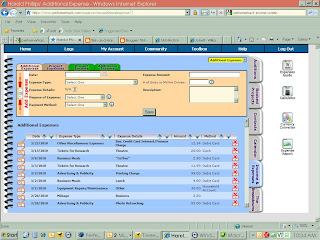
You'll note that four tabs appear on the top of the "Expenses" screen. If the receipt you're entering into PerformerTrack is related to a specific project (like, for instance, parking at an audition or dry cleaning a costume for a show), then you'll want to click the "Project Expenses" tab and choose the appropriate project from the yellow menu at the upper-right of the screen (that drop-down menu says "Additional Expenses" now, because that's the screen we're in!).


Fill out all the fields in the expense screen (whether "Project Expense" or "Additional Expense - the fields are the same). It's important to note that the "Expense Details" section changes, depending on the type of expense you're logging. So, for instance, if you're logging expenses for your Home Office - again, be sure you check with a tax professional about whether or not you qualify for the home office deduction - the "Expense Details" drop-down changes to list specific types of expenses associated with your home office (homeowners insurance, rent, alarm fees, etc.) The small red, white and blue icon next to that drop-down links you to PerformerTrack's online expense guide - a handy source of information on deductible expenses actors can track in the system.

See the little "blue cross" icons next to the "Purpose of Expense" and "Payment Method" drop-downs? Those icons indicate that you can create your own items on that list. This allows you to break down your expenses even further - you can track how much money you spent parking for auditions vs performances, for instance... or how much you spent on your credit card vs. your bank account.

Finally, be sure to note all the details about your expense in the "Description" box. This is a more expansive version of writing on your receipt - you can note the purpose of your expense, who you met with, what you discussed, or anything else that you think would help justify the expense should the IRS... uh... "ask" about it :).

Click "Save," and your expense is logged into the system. Seem like a lot of work? It's really not, once you get into the habit of entering your expenses ... and the payoff every April is well worth the time you spend. What pay-off am I talking about? Well, look at the far-right of the screen... do you see that white button labeled "Expense Report?" A little work every day/ week/ month entering your expenses into the system will pay off when tax time rolls around and all you have to do is click that button - producing a report of all your expenses for the year.


The income section works in much the same way - you enter the income you've made for each project into its own screen (you'll notice that there's also a section for "additional income"... I've never used this section, as all my income is related to some project I've worked on - but it's there).

There's a couple of things to note about PerformerTrack's income screen - See the spaces for "Gross Amount" and "Net Amount?" Recording these figures help you double-check to see how much withholding you've already paid on your W-2 income - and many agents base the commission you owe on your GROSS pay for a job, rather than the NET.

A large portion of union dues are based on a percentage of the union earnings an actor brings in every year. That's why PerformerTrack added the Union Affiliation drop-down. Many union performers have to scramble every year - again, the same way they do at tax time - to pull together pay stubs and memos, so they can figure out how much they owe their union in dues. When you enter your income into PerformerTrack, you can specify whether the income was SAG, AFTRA, Equity, etc... or whether it was non-union. If you've tracked this information in the Income screen, dues-time becomes a snap - all union performers have to do is run an income report, and their union earnings are displayed on one page. This saves a lot of time and effort!

Finally, take a look the PT and CT icons on the right side of the income screen. Remember my recommendation that you set up a bank account for your acting business? One of the many advantages to keeping a business account is the ability to hold a percentage of your income back to pay for your acting expenses. Like headshots - you know you need them. Saving a portion of your acting income in your business account will help you pay for them in a matter of months!

PerformerTrack calls this your "Performer Trust" account. This area of the expense screen prompts you to hold back a certain percentage of your acting income for these business expenses. Just choose "Yes" in this area, and the system will calculate an amount to hold back - from 2.5% to 20% of your pay check. You don't have to hold money back in your "Performer Trust" account... but if you ever want to get ahead and pay for some of those expenses, the cash has to come from somewhere! You'll note that there's a Performer Trust Report button on the right side of the screen... you can pull up a report at any time to see how much you've saved towards that new reel or pair of shoes.

The second icon, "CT" is a Child Trust tracker. Parents managing their children's performing careers are familiar with the Coogan Law - I'm not as familiar with it because, well... I don't have kids who are actors. My understanding, though, is that parents are required to withhold 15% of all their child actors earnings in a trust account. This area in the PerformerTrack income screen lets you track the amount deposited into that trust account. I'm obviously weak in this area... for more information take a look at this section of the official PerformerTrack site.

Again, all the details PerformerTrack's income system asks you to record may seem a little daunting... but when Tax-time comes around, being able to print a report detailing all your income can't be beat! No more sorting through W-2's and 1099's, adding up gross vs. net figures... once it's in the system, you can just run a report and transcribe it onto the appropriate tax form - or drop it off with your tax preparer. He/she'll be very grateful to you for making the job so much easier!

I'm sure that after all this, you can see the advantage of tracking your income and expenses in PerformerTrack - and now is the time to start! We're not too far into the year, so adding the income you've made and the expenses you've put out this year wouldn't be as long a process as it would be in, say, September! As I mentioned in the last post, HoldonLog has offered my readers a special discount: if you want to check the system out for yourself (and I'd highly recommend that you do), you can save 20% off a one-year subscription by entering the coupon code PORTLAND9 in the check-out screen. Now's the time to get started... before those receipts and pay stubs start to pile up again!

Next week we're going to take a step back from just tracking your income and expenses for taxes... we're going to talk about using your money to help build your business, rather than letting the money control your decisions. Until then...

Let's get to work!

-Harold

Labels: , , , , , , , , , , , , ,

Wednesday, March 24, 2010

Back-To-Business: A Taxing Situation IV - Mailbox

The Back-To-Business Series: Index

Hi there folks... did you think I'd forgotten you? Sorry about the late post today; I had to suspend this morning's answering of your questions to run to Oregon Public Broadcasting for a voice session. I'm back now, though... lets dig into the inbox and see what some people had to say about Monday's post on Tracking Tools.


... but I'm confused about mileage tracking. I thought that actors couldn't dedcut mileage for going to rehearsals and shows. JD (Athens, GA)

Ok - say it with me - I'm not a licensed tax preparer, so don't take my word for this. If you've got questions about what you can deduct and what you can't, please please please spend a couple of bucks to see a tax professional and get those questions answered. If the IRS calls your deductions into question, you want an expert by your side to defend the deductions you've taken... and I can't do that for you!

With that being said, here's my understanding of the situation: The IRS doesn't allow people to take "commuting miles" as deductible; that is, you can't write off the miles you drive from your home to your job. You can, however, write-off mileage from one job site to another. So, for example, you can't write-off the mileage you drive from home to the coffee shop you work at. If you go from that coffee shop to the bank so you can deposit the night's take, however, you can deduct that mileage (you just can't deduct the mileage from the bank back home.)

Now, as actors our job sites are casting offices, theaters, film sets, and the like. We have to follow the same rules as everyone else - we can't deduct the mileage we drive from home to those job sites. As sole proprietors of our own businesses (remember, that's what filing a Schedule C makes you), though, We can deduct the mileage we drive from our offices (one job site) to these other sites. The key to justifying this mileage is to be sure that you've got a qualified home office set up.

Now, again, I'm not a licensed tax professional - you should definitely consult with a licensed expert to be sure your home office qualifies for the home office deduction. If it does, then all mileage from your home office to your job sites is deductible - when you're doing a Schedule C job. When you're doing a W-2 job, you've been hired as an employee by the production company, so all mileage from home to the job site is considered "commuting miles," and is therefore not deductible.

One more time... consult a licensed tax professional if you've got questions about the specifics of the mileage you drove this past year...

... I don't get how my calendar is going to help me "justify" my expenses. It's just got my appointments in it, doesn't it? BR (St. Louis, MO)

... What do you mean about meetings? I'm not Sandra Bullock, "taking meetings" with big-time producers to pitch my latest movie. I'm just another Portland actor out looking for work. AF (Portland, OR)

These two questions actually relate to each other. A lot of the "business" of show business doesn't take place on stage or in front of the camera. It doesn't take place in the rehearsal room, or at your agent's office. A lot of the "business" of show business takes place at parties, bars, coffee shops, and restaurants.

It's been said that show business is a "personality" business - that how you come across to producers/ directors/ casting agents in informal situations (such as Portland's weekly Leverage viewing parties, or at film premieres) goes a long way toward your getting work on that next project - or on a project a year down the line. While people outside "the business" look at film screenings and industry parties as glamorous events where pretty people rub shoulders, those in "the business" look at them for what they are - business events. Opportunities to get to know the people who have the power or influence to get you hired on that next job. Opportunities to be seen, and to promote yourself. Like any other activity geared towards building your business, what you spend on these events is a legitimate deduction.

See, you never know who's going to help you get that next job. It could be that director you met at that party that actor threw... or it could be the young actress you go out to coffee with after rehearsal. Or, it could be the grip you introduced to a the aforementioned director over lunch - he hears about an opening on another project, and he could very easily put in a good word for you. Just about all our activities with industry contacts can lead to future work... which makes all of our lunch/ coffee/ bar dates business meetings - if you talk business with those contacts.

Which brings us back to our calendar... noting every meeting you have with industry contacts helps you to justify the miles you drive to get there, the meal and/ or drinks you buy (only half of that amount is deductible, though...), your parking, etc... an actor friend calls you up on the spur of the moment and says, "Hey, lets grab lunch?" Go - but be sure to note the meeting in your calendar! Not only will it help you justify the expense - it'll remind you about the meeting when you're hunting for deductions at tax time!

And, finally, here's one I get asked a lot!

You're always out there pimpin PerformerTrack - do you work for them or something? SD (Antioch, TN)

No, I don't work for HoldonLog, the company that makes PerformerTrack. I'm just a very satisfied user of the web-based system - it's been an invaluable tool for me over the past three years. Since I started using PerformerTrack (and its predecessor ActorTrack), I've started thinking of my acting career as a business - in fact, a lot of the information I share with actors in my Personal Business Coaching sessions and here on the blog are derived from the lessons I've learned by using those systems.

We'll talk more about PerformerTrack in next Monday's post... and don't be surprised if you hear more about it in coming weeks as well. It really is a great way to take charge of your career!

Until then...

Let's get to work!

-Harold

Labels: , , , , , , , , , ,

Monday, March 22, 2010

Back-To-Business: A Taxing Situation IV - Tracking Tools

The Back-To-Business Series: Index

We're going to finish up our discussion on taxes by looking at some tools to help you track your career activities throughout the year. A lot of the actors I work with in private Business Coaching sessions spend weeks every March and April trying to reconstruct their activities from the past year - pulling together receipts, going through old rehearsal schedules, and compiling list upon list to transcribe onto their tax forms. Tax season doesn't have to be so frustrating - a lot of sweat and effort can be a avoided if you'll just take a little time during the year to log your income, expenses, and career activities; that way when April rolls around you'll have all your information in one place so you can gather it together with ease, get your taxes filed... and getting back to doing the work you want to do: auditioning and performing!

>> You don't have to spend a lot of money on these tools. We've already talked about one cheap-and-easy-to-use option that makes tax time easier - an Accordion File can help you separate your receipts into deductible categories (be sure to note the purpose of your expenditure on the receipt... more on that in a minute). Other less expensive tools like these can help you keep track of expenses you don't get receipts for - like the miles you drive to conduct business (including trips to audition, perform, meet with producers and directors, check your mail, go to the bank...)

That mileage is a legitimate deduction (within certain boundries - be sure to consult a licensed tax preparer to get all the details.) The thing is, you have to keep track of it - and you have to produce a log to prove you drove those miles for legitimate business purposes if the IRS asks ("asks" is such nice term for an audit, don't you think?) At the very least, be sure to note the date of the trip, the miles driven, and the purpose of the journey. To be totally prepared to justify your mileage to the IRS in an audit, you should also list your car's odemeter reading at the beginning of the year, the beginning and the end of the each trip, and at the end of the year.

Sounds like a lot of information to record in a simple notebook, doesn't it? Maybe one of these is a better investment - for a little more money you can get a pre-printed booklet to fill out every year. Just keep it in your car's glove box, and pull it out every time you make a business-related trip!

>> Did you notice that word I used a couple paragraphs back - justify? I hope you never have to go through an audit, but if you do the IRS is going to expect you to justify the expenses you've written off on your taxes - prove to them that the money you spent was used to conduct or build your business. That's why we make notes on the receipts that we save every year - if anyone asks, we can tell them (for example) WHO we had coffee with and WHAT was discussed and HOW that meeting contributed to our performing business.

An actor's most important tool can also help to justify his or her expenses: the calendar. You probably already use a calendar to keep track of your auditions and appointments (at least I hope you do!) - whether it's small and pocket-sized, a larger "Day Runner" style, or an electronic PDA (I myself have opted for the "Smart Phone" option - my Blackberry Storm carries all my calendar and contact data in one compact package. It's very handy!) Noting every class, audition, performance, meeting, or appointment in your calendar - yes, EVERY one - will give you extra amunition in case you have to justify your expenses to the IRS.


Lets face it - the IRS knows that anyone can write a note on a receipt at any time, claiming that a lunch at Kornblatt's Deli was a business expense and not a personal one. Having that lunch documented in your calendar, though, and noting who you're meeting with and why is going to help support your receipt - and make it look a LOT more legitimate if the IRS "asks."

>> Of course, the point of all this was to make tax time easier, not harder... all this seems like a lot of work, doesn't it? Making notes on receipts, filing them, writing appointments in your calendar, noting your mileage... and that doesn't even begin take into account the work of pulling all that data together at tax time. Isn't there an easier way to get all your tax information together in one spot?

Of course there is... and regular readers of my blog have probably already figured out what I'm going to recommend:


HoldonLog's PerformerTrack "webware" combines all the tools I've mentioned above - your calendar, your mileage log, your receipt file... and it makes tax-time a breeze by letting you print out reports in April (or whenever you feel like it) that breaks down your income and expenses. You still have to use the system - entering in appointments, income and expenses... but entering it in once gives allows you to access that data any time, and saves you the trouble of stacking paperwork and transcribing at tax time.

It also saves you the trouble of going through those bank statements I mentioned last week... entering in your income as it comes in produces a report of everything you've made in the past year. An extra bonus for union actors - income can be categorized by union, so at dues time you don't have to hunt for pay stubs to figure out how much you owe (we'll get into that a little later...).

Next week I'm going to take an in-depth look at PerfomerTrack, and show you how using the system can help make tracking your income and expenses a snap. If you don't want to wait, though, visit the http://www.performertrack.com/ and take a look for yourself! PerformerTrack is a subscription-based service (though it doesn't cost much - a yearly subscription works out to just $9.95 a month), but I can help you out there... Because I believe every actor can benefit from using their system, I've worked it out with HoldonLog to offer my readers a special deal. You can save 20% off a one-year subscription to the system by entering the coupon code Portland9 into the check-out screen. That drops the subscription price down to $7.96 per month... a lot of Portlanders spend that in two days at the coffee shop.

As always, feel free to email me your questions or comments... or send them to me on Twitter! For now...

Lets get to work!

-Harold

Labels: , , , , , , , , , , , , , , , , , , ,

Wednesday, March 17, 2010

Back-to-Business: A Taxing Situation III - Mailbox

The Back-To-Business Series: Index

Hey there folks

I actually got quite a bit of mail related to my last post in the Back-to-Business series. Some people were surprised when I suggested setting up a separate account for their acting income, and had a lot of questions about how to go about doing so, like...

... what you say makes sense, and I think I'll go ahead and set up a new account. I haven't made any money acting yet, though - won't my bank need me to put some money IN the account when I set it up? JL (Philadelphia, PA)

... what I want to know is what's the best bank to set up an acting account at? AS (Saint Paul, MN)

...When it comes to using money I have earned from my day job to pay for say a class or head shots, would it be best to take the money out of my personal account and deposit it into my business account in order to track the expenses and then note the deposit was not a payment for services or just pull from my personal account? LH (Portland, OR)

They probably will, JL. Depending on your Bank's policies, they might want as little as $5.00 or as much as $100.00 to start a new account. That doesn't mean that you have to make $5 or $100 as an actor before you set up your business account, though.

LH's question touches on this fact - businesses get venture capital all the time to help them start up; there's no reason why YOU can't invest in your business, just as a venture capital firm would, to help pay for your start-up costs. Just "loan" yourself the money you need to open the account - but record it in your records as a loan, not as income.

We're going to get a little more into basic accounting in a future post, but think of it like this - you as an individual are loaning your business a certain amount, with the understanding that your business will pay back you - the individual - in the future. Make a commitment to yourself (as a start-up business would commit to its investors) to pay that loan back within a year - heck, you can even commit to paying the loan back with some sort of interest. Setting things up with this in mind starts you down the path of thinking about your acting business as a business - It's makes your career about more than just going "finding a job." It focuses you on building a profit that you can return to your biggest investor - yourself.

As to the "best bank" to set your business account up at, AS... I can't really make that judgement for you. You have to look at the types of fees the banks in your area charge, whether they have a minimum balance requirement (more on that in a second), whether they offer checks and a Visa or Mastercard debit card (essential for paying your business expenses!), location, hours of operation... etc etc etc.

I myself prefer to keep the money I make in my community, instead of giving it to a large private bank... we've seen what some of the large private banks have done with our money in recent years. With that in mind, I've opted to keep my business account at a local credit union here in Portland. That's me, though... you'll need to figure out which bank is right for your needs.

...It sounds good in theory, but I don't make enough from acting to keep the money in a separate account. I have to pay my family's bills and that takes every dollar I get. BJ (Oakland, CA)

I see your point, BJ. Hell, more than that, I know exactly where you're coming from - there are some months where my business account has around $23.00 in it because I've taken "draws" out to pay my family's bills (again, "draw" is an accounting term... we'll get into that in a future post). We run into unplanned expenses from time-to-time, and the money has to come from somewhere. Luckily, the money's there - and it's ours to use.

Don't think of your business account as a "lock box" that you can't touch (remember Al Gore and the "Lock Box?" Still comedy gold...) If you're a Sole Proprietor, then you don't have to keep every dollar you make "locked up" for your business. You're not paying anyone's pension (unless you hire employees... but that's another subject entirely). As far as the IRS is concerned, your Schedule C income is yours to do with as you will.

This actually touches on another question I received:

... so if I put all the money I get from acting into a business account, how do I get it? Do I write myself a check for a salary? KD (Albuquerque, NM)

Yes and no. This is one of those accounting things we're going to get into later on... but as I said above, the IRS considers your 1099 income your money, to do with what you will. That means that you can write yourself a check (or transfer funds electronically through online banking) any time you like. It's not salary per-se, though... salary is an expense that businesses pay to employees. Since you're not an employee of your acting business - you're the OWNER of the business - you don't get a salary. You get paid as a "draw" on your business's "equity..." which isn't recorded as an expense for tax purposes.

As I keep saying, though, concepts like "draws" and "equity" are topics for a future post. For now, we're going to focus on tracking your income and expenses for tax purposes - and next week we'll focus on some tools for helping you do that throughout the year so tax season won't be so taxing. Keep your questions coming - email them to me, or feel free to shoot me a message on Twitter. Til then...

Let's get to work!

-Harold

Labels: , , , , , , , , , , ,

Monday, March 15, 2010

Back-to-Business: A Taxing Situation III - Bank Run

The Back-to-Business Series: Index

So, my last post left you with a little tease... I mentioned a way for you to get all your business income and expenses for the year tabulated on a sheet of paper, and sent to you in the mail (or electronically) every month. Of course you probably already have something like that sheet of paper... it's called a bank statement. Now, the bank statement you receive is most likely for your personal bank account - it's not going to help you separate out your business expenses, though -unless you set up a separate bank account for your acting business.

Now, a lot of my new business coaching clients freeze up when I suggest they open a separate business account... it sounds complicated; it sounds like a lot of work; it sounds expensive! Before you start to hyperventilate over the idea, think about it - does the CEO of Target pay his company's business expenses out of the same account he pays his family's grocery bill with? That'd just be silly - and improper... the IRS frowns on people dipping into company funds to pay for private expenses! I think they have a word for that... starts with the letter E...


Lets go at it from a different angle - does a plumber buy his supplies out of the same account s/he pays the rent with? S/he could... but there are a lot of costs associated with running his/her business - does s/he really want to come up short on the rent next month because s/he had to buy a few too many flapper-valves? Sounds like risky business... and not the kind with Tom Cruise and Rebecca De Mornay. S/he keeps the business funds separate from his/her personal funds - and s/he "pays him/herself" periodically out of the business funds to cover personal expenses.

Remember what I said last week about 1099 income and "Schedule C's" - if you're reporting to the IRS on a Schedule C, they think of you as a business. That means you have to behave like a business - just like the CEO of Target or our hypothetical plumber. Otherwise, our friends at the IRS might not accept your income as business income. They might decide that its "hobby" income instead... and like I said a while back, a model train collector can't write off his/ her tracks.

Besides, it's not really all that complicated... most banks or credit unions will let you open a second checking account for little or no money. Your business account doesn't necessarily have to be what your bank calls a "business account" - an account which often has extra fees associated with it. If you're running a Schedule C business (as opposed to a corporation or LLC), all you need is a separate checking account to put your 1099 income into, and to pay your 1099 expenses out of.


Paying your acting expenses out of your business account has an added advantage - aside from seeing all your business income and tax deductible expenses laid out every month on your bank statement. It gives you a fund to save up for those business expenses. How many times have you heard an actor say that s/he needs new head shots, but doesn't have the money for them? If you put all your acting income into a separate account, and leave a portion of that income in the account after taking a "draw" for you personal expenses (that's an accounting term that I'll go into in more detail later)... then you'll build up the money needed to get those new head shots. Or that new PDA. Or to pay for that demo reel. Or... you get the picture.

But wait a minute... What about W-2 income and expenses? Remember the difference between 1099 (or Schedule C) income and W-2 income... 1099 is "self-employment income", and W-2 is "Wage" income. If you get paid as a W-2 employee, you can still take expenses related to your career off on your taxes (the rules for this are a lot more restrictive, though - consult a tax professional in your area about this). The income you receive, however, is categorized by the IRS as the same type of income you might get from a restaurant, or as a temp - it's not "business" income in the IRS's view. They expect that pay check to go right into your personal checking account.

A lot of actors still want to get a statement of their acting expenses every month, though - even if they're primarily paid W-2 income. They use a credit card for this purpose - they simply charge all their acting expenses to the credit card, and they pay the card from their personal account. Depending on the way your taxes are structured, you might even be able to deduct the fees and interest on that credit card - but again, these rules are very restrictive, and you should really check with a licensed tax professional on the details.

I myself am not the biggest fan of credit (and by extension, debt) - I've seen too many people get in over their heads by thinking they can charge something now and pay for it later... and later... and later... all the while getting buried in interest fees. If you decide to go this route, be sure that you've got the money to pay off your credit card balance at the end of the month. Don't get dragged down paying off debt you've accrued, when you could be putting that money towards saving up for the tools you need to do the job - and the tools that make doing the job easier.

Here's the thing, though - how are you going to know whether you have enough money to pay off that credit card balance at the end of the month? We'll go into some tools to help you keep track of your money - both W-2 and 1099 - in next weeks post... and these tools will make next year's taxes even easier! I'll see you then - remember, you can always email me your questions, or pose them to me on Twitter. I answer reader questions each Wednesday (or, some times, I write a whole new post around them!) For now...

Lets get to work!

-Harold

Labels: , , , , , , , , , , ,

Wednesday, March 10, 2010

Back-To-Business: A Taxing Situation II - Mailbox


Hi folks

As you might expect, the late posting of my last Back-to-Business article contributed to a significantly lower amount of email and comments... I did get a few though. A lot of them sounded like this:

... Seriously, THAT'S your tax advice? Keep your receipts? I already do that... (Many and varied)

I know, I know... it seems pretty simple, doesn't it? The key isn't saving your receipts, though - the key is putting them all in one place that you can find easily at tax time. A lot of actors have to comb through their bedrooms, home offices, and cars every April looking for their receipts - that's why a simple accordion file can be such a useful tool. By labeling the pockets by category and putting your receipts in the appropriate pocket throughout the year, you'll save yourself a lot of time (and stress) at tax time.

... Or you could just do what I do - take your receipts to a CPA and have her do your taxes. It's totally worth the money. (KA, Tempe AZ)

You're totally right, KA - and the money you pay your tax preparer is totally deductible as a legitimate business expense :) There's still something to be said for organizing your materials before taking them to your tax person, though; most tax preparers bill by the hour. If you just walk in with a big brown box full of receipts, W-2's, 1099's, and pay stubs... you'll be paying them for the time it takes to sort through them and put them in order. It's worth the time to do the sorting yourself before you bring your materials to a tax professional.

Besides... it's also a good excuse to look over the past year and realize how much you spent on advertising... or networking... or how many miles you drove!

Well, that's it for now folks. As always, feel free to email me your questions - or pose them on Twitter. Just remember that I'm not a licensed tax professional; if you have any questions about your specific situation, you should totally (as KA says) ask a licensed tax professional.

Next week we'll talk about how you can get all your acting income and expenses printed off for you automatically, and delivered right to your mailbox. Until then...

Lets get to work!

-Harold

Labels: , , , , , ,

Tuesday, March 09, 2010

Back-To-Business: A Taxing Situation II - Track The Money

Sorry about the late post, folks... once again, the "scheduled posting" function doesn't seem to have worked on Blogger; I need to get better about checking to be sure my posts go up when they're supposed to. My apologies!

The Back-to-Business Series: Index

So, do you hate me after last Monday's post? Did you curse and scream your way through collecting receipts and figuring out how much you drove and whether that drink you had with your actor friends was a legitimate expense or not?


Sorry about that guys... I really am. It stings me more than you know to see actors sweating at tax time, trying to pull all their paperwork together in a race to get their taxes in by the deadline. It really doesn't have to be that way - not if you do a little preparation and management throughout the year.

A large part of my private business coaching sessions with actors is dedicated to setting up systems; systems that - when they're followed regularly - make tax time a lot easier, and keep actors on top of their business throughout the year. Over the next few weeks we'll go over some of these systems - and hopefully you'll start keeping track of things, making next April a lot easier.

As I said in the first post of this series, IRS rules determine a lot about how we do business. The IRS tells us what expenses we can write off - and by doing so, they tell us what we should be investing in to grow our business. You've probably heard the old saying "you have to spend money to make money," right? That saying gets to the heart of what we report to the IRS every year - expenses and income - and it also gives a nod to the reason for most of the stress people feel at tax season: the hustle of pulling together all their pay stubs and receipts to show how much money they spent to make their money.

You can cut down on that stress a great deal if your acting business income and expenses are already separated from your personal income and expenses. One of the simplest and cheapest tools an actor can use for this: a manila file folder. That's it - costs you just a few cents per folder. When you buy something for your business, you put the receipt for that purchase in the manila folder (making sure to note the purpose of the expense - like "Lunch with Director ____," or "Photos by ___"... you get the idea. Remember, if you ever get audited, documentation is everything!). When tax time comes around, you open up the folder, separate your receipts into the categories listed on Actors Tax Prep's handy expense list, and you get to work filling out your tax form.

Hey, while you're at it, invest another few pennies in a second manila folder, and put the pay stubs for jobs you've worked during the year (or copies of the check, if there's not a stub enclosed) into it. That way your business income is ready to be reported as well - you just have to sort it into W-2 and 1099 income!

But wait a minute... that's not really making the tax process much easier... you still have to sort your receipts and pay stubs to get your taxes ready. There's got to be a better way to do it so you don't have to spend so much time in April... what if we pre-sorted our expenses and income into the appropriate categories during the year? It'd be a pain using our manila folder method... you'd have to open the folder every time you got a new receipt, paper-clip it to the other receipts in that category... eh. What a pain!

Unless there was a way to divide your expenses and income into categories automatically... like, maybe, one of these? Costs a little more than a manila folder... but it saves you time in April, because you can assign a category to each pocket at the beginning of the year, and then drop your pay-stubs or receipts into the appropriate pocket as the year progresses. Come tax-time, your paperwork is all pre-sorted.

Except... You still have to take the time in April (or March, if you're on top of things) to pull all that paper out and sort it, add up the numbers, and transcribe it onto your tax forms. Still seems like a lot of work, doesn't it? Isn't there a way to get all your income and expenses onto one sheet of paper, without all that labor?

Of course there is... and you probably get one of those sheets of paper in your mailbox every month! Next week we'll talk about your bank statement, and how you can use that to help you run your business... and get you ready for next year's tax season!

Lets get to work...

-Harold

Labels: , , , , , , , ,

Monday, March 01, 2010

Back-To-Business: A Taxing Situation


(If you're here looking for a list of deductible acting expenses, then click here to jump to the Expenses section of this post.)

So, here it is. The first day of March, and April 15th is right around the corner. If you're like a lot of actors out there, you're dreading the approach of tax day - you know you need to get your paperwork together and your taxes filed, but you can't quite make yourself sit down and do the work. You know that you should be able to find deductions that will increase your refund (or at the very least, reduce the amount you owe), but you're unsure of what you're allowed to write-off... and if you do know, you're not sure how much you spent last year. I know, I know... it's paralyzing!

Stop. Take a breath. Tax time doesn't have to be so... taxing. Today we're going to talk about some tax-time basics - the stuff you have to know to get your taxes filed this year. Along the way, we'll be talking about some core concepts - the why behind the what. Then, next week, I'll pass on some tips to help structure the way you do business in the coming year - to make next year's taxes easier, and the process less of a burden.

Before we go much further, I want to make something abundantly clear - I'm not a tax professional. If you have ANY questions about the specifics of your tax situation, don't take my word for things - consult a licensed tax professional. I'm just going to speak in general terms about things I've learned over the years as a professional actor. Oh, sure, you can still email me or pass your questions to me on Twitter - as always - but "Harold said so" isn't going to do you much good if you're ever audited. Learn the names and numbers of tax professionals in your area who understand the special needs of performers, and invest the money to get solid advice when you need it... it's worth it, and hey - it's a deductible expense!

Now, I said at the close of last week's post that the IRS determines a lot about how we do business... and it's true. Whether you like the concept of taxation or not, any time money exchanges hands in the United States our friends at the Internal Revenue Service want to be involved. There are ways to minimize the amount of money that you pay the government, but it will always expect its cut. As Mr. Franklin said, "In this world nothing can said to be certain except death and..." Now, any time money changes hands for a service, there's a business relationship... and the IRS governs those relationships as much as (or perhaps more than) any other body.

So, lets talk about that exchange of money for services... Without going into the vagaries of the tax code (and again, I'm not a tax professional) there are two types of income that actors bring in through their work. These income types are usually referred to - as a kind of short-hand - by the forms you fill out when you start working on a project. Many of you are probably most familiar with W-2 income or "Wages" - that's the type of income you most likely bring home from your "survival job - " the restaurant or office you work at gives you a check on pay-day, and they withhold from that check the taxes, social security and medicare contributions you owe the government. When you file your taxes, you balance the amount withheld from the check against the amount of money you made... and that formula determines whether you owe the IRS a check in April or whether they send you a refund.

The other type of income that actors generally bring in is 1099 income or self-employment income. This is also referred to as Schedule C income (after the tax form you file to report it) and, sometimes, as Contract Income. There's a good reason for that last term: Self-employed people generally sign a contract at the outset of a project (at least they should...); that contract stipulates how much the "contractor" will be paid for his or her services. Money is not withheld from the fee paid on a contract, so the contractor is responsible for for paying the taxes, social security and medicare contributions owed to the government on that amount.

(There are other forms of income that the IRS taxes, including Farm and Interest income, capital gains, etc... again, consult a licensed tax preparer for more information on these. I'm mostly talking about the type of money an actor is going to be paid for his/her work over the course of a tax year.)

A little story about the difference between W-2 and 1099 income... when I was 18, I went to work for the University of Alaska, Anchorage in their summer stock program. I was paid what I considered a princely sum at that time... something along the lines of $1100.00. At the end of the summer stock season I did what most 18 year-olds would do - I pocketed the money, ate lots of pizza, drank my fair share of beer, and went about my collegiate life. When it came time to file my taxes the following year, I was stunned to find out that - for the first time in my life - I owed the government a check for my taxes.

Up until that point I'd just worked in restaurants or TV stations, filed my form 1040, and gotten a refund. The difference was the 1099 income I'd received from the University - nothing had been withheld from the check I got from UAA, so there was money due. That was a very lean month around my college household, as I scrambled to pull together the needed funds... remember, the Government always wants its cut!

So, as mentioned above, 1099 income is "self-employment" income, and it's reported to the IRS on a Schedule C, which is attached to your standard tax form - Form 1040... where your W-2 or Wage Income is reported. Got that? (That's ok... feel free to read it again. I can't imagine how anyone could be confused - I mean really! :) )

Actors do receive W-2 income - especially if they're members of SAG, AFTRA, or Equity - union contracts are generally administered through payroll companies, which take care of withholding. A lot of our work, though, is payed for on a 1099 basis - especially here in smaller markets where there's more non-union work than union. As I said before, the IRS always wants its cut - and they'd prefer it if we give them the tax on our expected earning quarterly - in the form of estimated taxes. This is the 1099 version of withholding. You can choose not to pay quarterly estimates, and instead pay the total tax owed in April... but there will be a penalty assessed - and depending on how much 1099 income you made that year, it can be STEEP!

So, we pony up every quarter - or we pony up in April - to pay the tax on our 1099 income... but there is a little salve for that pain. The IRS considers Independent Contractors (anyone filing a Schedule C for their 1099 income) businesses, just like Coca Cola or General Motors. Those companies have to pay for things in order to make and sell their products - and so do we. Coke and GM get to deduct those expenses from their annual taxes, thereby lowering their tax debt... and so do we! You see, the government taxes a businesses profit - the amount of income that business has made minus the expenses its paid. So, if we want to be taxed on just the profit we've made from our 1099 income (and not the sum total of all we've been paid), it's up to us to tabulate our business expenses.
We can do the same thing if the majority of our income is W-2 income... but that falls into the "itemized deduction" category of your 1040 form. There are some restrictions on the deductions that you can take on W-2 income - consult a tax professional about these.

Consider - because we run a business (I'll call it "Actor Inc." - though that's not to say you should incorporate... there's a topic for another article...) we have to advertise to prospective clients.. just like Coke and GM. We get photos taken and printed. We have reels cut together by editors. We keep web sites to advertise our services. We have to get ourselves to auditions, rehearsals, shoots, and screenings - and we have to park at all those places. We pay to train in our craft... we pay commissions to our agents and managers - and some times we have to pay lawyers, bookkeepers and doctors. We have to pay dues, subscribe to trade papers, buy scripts... the list goes on and on (In fact, the list is right here, courtesy of LA's Actor's Tax Prep. Print it off and keep it with you... it'll help you file this year's taxes, and help you in the year to come!)

Be careful with what you claim, though... We have to have tangible evidence that we've spent money on our business in order to write those costs off - which is why you've (hopefully) saved the receipt for everything you've bought or paid for to help run your acting business. If you don't have a receipt, and the IRS audits you, deductions for those costs will be disallowed... and you'll probably have to pay a penalty for claiming them in the first place.

Something else to watch out for: the IRS only extends this benefit to real businesses. As I said before, W-2 employees can write off most of the expenses they incur in pursuit of their jobs as well... but either way the "cost of doing business" is only deductible for a business. This seems like a simple concept... but actors who can't prove to the IRS that they're running a for-profit business tend to get in trouble - if you can't show the IRS that you do the work required to manage a business, they'll consider your acting career a "hobby" - and a model train collector doesn't get to write off the cost of his or her tracks. Unless you're actively running and managing the business of "Actor Inc.," they'll disallow all those write-offs you want to take against your income.

Which is why it's so important to track your expenses as you go about the daily work being a professional actor requires. If you've done that, then tax season should be pretty easy for you - you've probably got all of your receipts in one place, separated by job, by date and type of expense.
You've probably tracked your mileage or transportation costs for the entire year, and noted the purpose for each trip (and, if you want to be extra careful, the odometer reading of your car at the beginning and ending of the trip - in case the IRS wants proof of the mileage driven). It should be noted that there are some restrictions on this for W-2 income - be sure to consult a tax professional about this.

You've noted all the income you made in the past year (both W-2 and 1099) - whether paperwork was sent to you or not - and you've separated that income so you can note it on the appropriate form (1040 or Schedule C.)

You've got notes detailing the square footage of your home office (the area in your home set aside for no other purpose than to run your business). You've also noted your rent or house payment and utilities - so you can claim those items as part of your home office. Again, there are restrictions in this area - be sure to consult a tax professional before claiming a home office, to be sure you meet all the requirements.

You've got notes about when you bought equipment for your home office (or, for that matter, any equipment you use solely in your business) for depreciation .

You've got notes on any out-of-town trips you've taken, and you've kept the receipts for those trips separate from the other receipts for fuel, transportation costs, meals and lodging (per diem is a separate, deductible expense).

You can prove the business purpose of that dinner you had with a director, and you've noted his/her name on the receipt and what you met about.

If you've got all that covered... then you're ready to go! Start running your favorite tax program, or bring your materials down to a tax preparer and have him/ her start filing. If you don't... well, you've still got 45 days.

Next week we'll talk about how we can make next year's tax season a lot smoother... by setting yourself up to track your expenses and income as you go, instead of all at once at the beginning of the year. As always, feel free to email your questions (or send them via Twitter) - but remember, I can only speak to generalizations. I'm not a licensed tax preparer.

Lets go to work!

-Harold

Labels: , , , , , , , ,

Monday, February 22, 2010

The Back To Business Series


You know how I yammer on and on... This directory will help you find posts in the Back To Business Series. Remember, you can always send your questions to me via email or Twitter - you might just have your question answered in a Wednesday Mailbox post!


Labels: , , , , , , , , ,